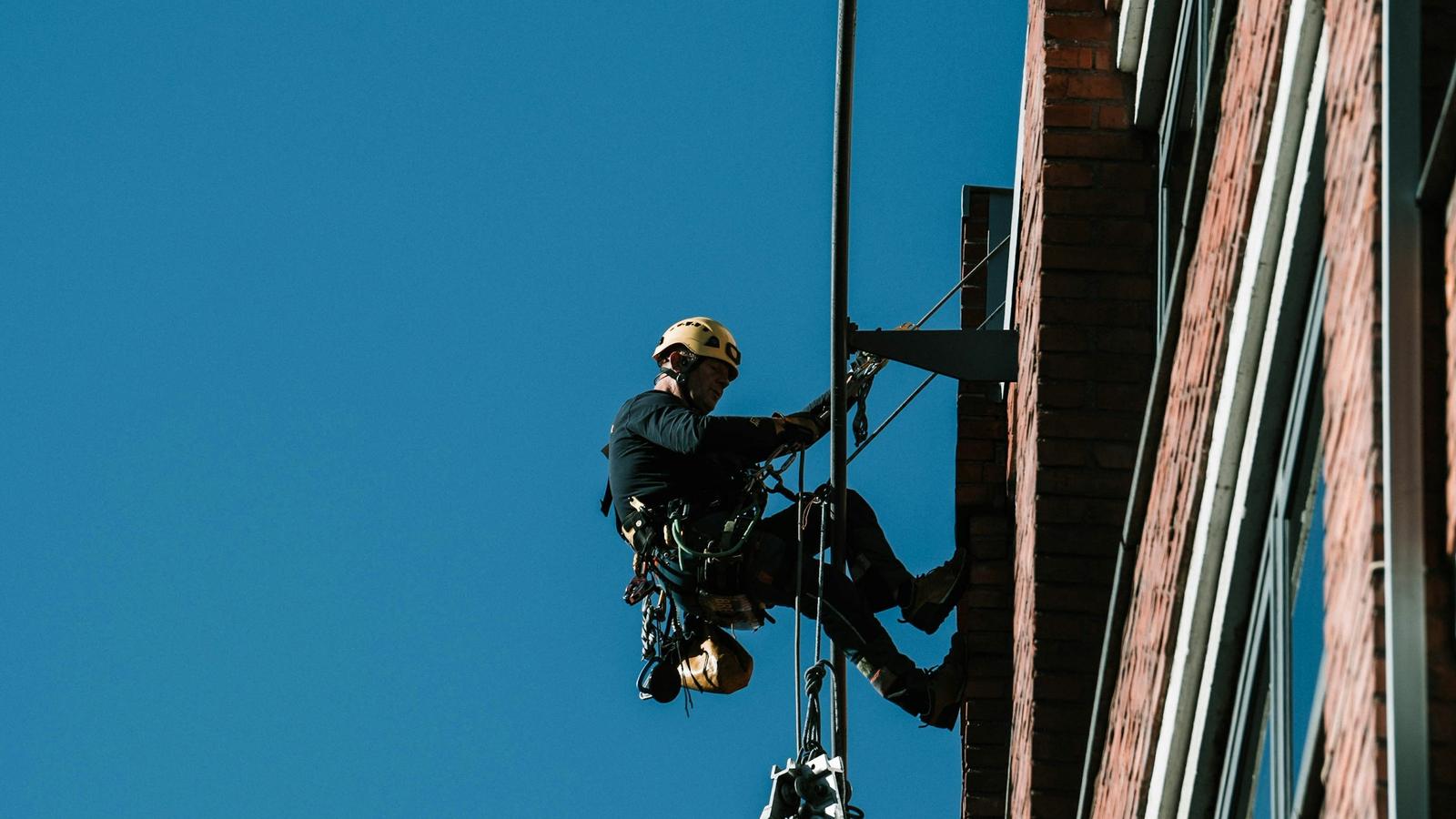
Rope access is used for inspection, maintenance, painting, facade cleaning and work on cranes, tanks and stacks. It differs from simply “hanging on a rope” because it is a complete work system with standards, certification and rescue procedures.
When is it the right choice?
- When the work is short, or spread over many locations that would each need scaffolding.
- When a boom lift cannot reach or scaffolding cannot be erected because of height or the shape of the structure.
- When operations or traffic below the work area must not stop, as in ports and industrial plants.
It is not the right choice for heavy work that needs a lot of material or a fixed working platform for a long period; scaffolding is more efficient there.
The two-rope system
Every technician is attached to two independent ropes, a working line and a safety line, each with its own anchor. If one fails, the other still protects the technician. This principle underpins the Industrial Rope Access Trade Association (IRATA) system and the international standard ISO 22846.
Technician levels
- Level 1: carries out defined tasks under supervision.
- Level 2: an experienced technician who rigs rope systems and performs rescues.
- Level 3: the supervisor responsible for work-site safety and the rescue plan, who must be present on every site.
The rescue plan comes first
Work does not start without a written rescue plan for each site, rescue equipment ready to use, and a team able to reach and lower a technician quickly, without relying on outside emergency services alone; prolonged suspension in a harness after a fall is a hazard in itself.
Equipment and inspection
- A visual and tactile check by the technician before every use.
- Documented periodic inspection by a competent person to the manufacturer’s instructions.
- A record for every item: ropes, harnesses, descenders, ascenders and connectors.
- Withdrawal of any item that has arrested a fall, is damaged or has passed its service life.
Site set-up
A marked exclusion zone below the work, rope protection at sharp edges and hot surfaces, weather and wind checks before and during work, a work-at-height permit, and tethered tools to prevent dropped objects.
Rope access safety rests on three things together: certified technicians under Level 3 supervision, an independent two-rope system, and a rescue plan ready before work starts.